Quality Sistema Certifications and Inspections
ISO Certification in Austria: Build Trust, Improve Compliance & Grow Your Business
In today’s global business environment, organizations are expected to deliver consistent quality, maintain safe workplaces, protect sensitive information, and operate responsibly. Whether you serve local customers or international markets, following globally recognized management standards helps strengthen your reputation and improve business performance. This is why many organizations choose ISO Certification in Austria as a strategic investment for long-term growth rather than simply a compliance requirement.
Austria has established itself as one of Europe’s most stable and innovation-driven economies. The country is home to globally competitive industries such as advanced manufacturing, automotive engineering, information technology, healthcare, pharmaceuticals, food processing, renewable energy, logistics, construction, and professional services. Austrian businesses also benefit from access to the wider European market, making internationally recognized management systems increasingly valuable when working with customers, suppliers, and business partners across borders.
At Quality Sistema Certifications & Inspections, we help organizations implement practical management systems that improve efficiency, reduce operational risks, and support continual improvement. Our approach focuses on understanding each organization’s business objectives before recommending the most suitable certification solution. Instead of providing generic documentation, we develop management systems that integrate with existing business processes and create measurable operational improvements.
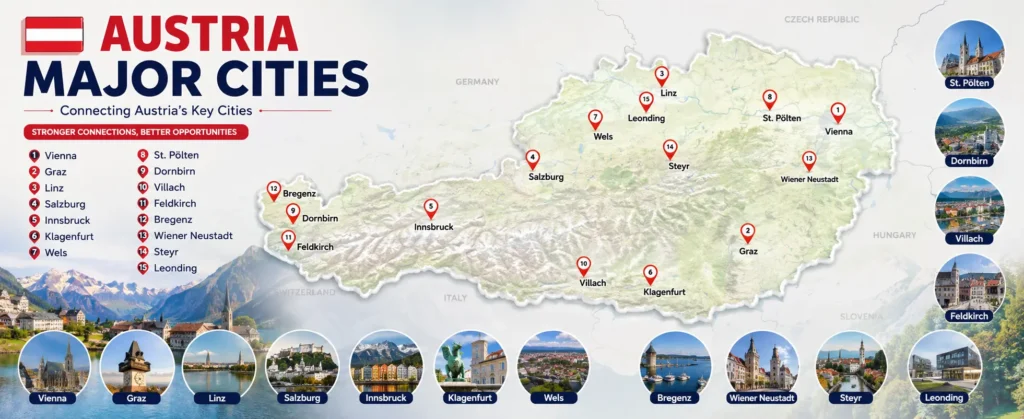
Whether your organization operates in Vienna, Graz, Linz, Salzburg, Innsbruck, Klagenfurt, Wels, St. Pölten, Dornbirn, Bregenz, Villach, Feldkirch, Steyr, or Wiener Neustadt, our experienced consultants provide professional guidance throughout every stage of the certification journey.
Why ISO Certification Matters for Austrian Businesses
Modern organizations face increasing expectations from customers, regulators, suppliers, and international partners. Companies are no longer evaluated solely on the products or services they deliver; they are also assessed on how effectively they manage quality, environmental responsibility, workplace safety, business continuity, and information security.
Implementing ISO Certification in Austria helps organizations establish structured management systems that improve daily operations while supporting sustainable growth.
Businesses can benefit by:
- Improving customer satisfaction through consistent quality.
- Enhancing operational efficiency by standardizing business processes.
- Reducing operational risks through proactive risk management.
- Strengthening compliance with applicable legal and regulatory requirements.
- Building credibility with international customers and business partners.
- Supporting continual improvement across departments.
- Increasing employee awareness and organizational accountability.
- Improving supplier confidence and tender eligibility.
Creating a stronger competitive position in European and global markets.
Rather than treating certification as a one-time achievement, successful organizations use ISO management systems as practical tools for improving performance and making informed business decisions.
Industries We Support Across Austria
Different industries have different operational challenges, regulatory obligations, and customer expectations. Our consultants work with organizations from diverse sectors to implement management systems that align with their business objectives.
We provide implementation support for:
- Manufacturing & Industrial Engineering
- Automotive & Automotive Components
- Information Technology & Software Development
- Healthcare & Medical Services
- Pharmaceutical Companies
- Food Processing & Beverage Manufacturing
- Construction & Infrastructure
- Logistics & Transportation
- Warehousing & Distribution
- Renewable Energy
- Educational Institutions
- Hospitality & Tourism
- Retail & E-commerce
- Chemical Industries
- Professional Service Organizations
Each implementation project is customized according to the organization’s size, business processes, operational risks, and industry-specific requirements, ensuring the management system remains practical and sustainable.
Cities We Serve Across Austria
Our certification support is available throughout Austria, including:
- Vienna
- Graz
- Linz
- Salzburg
- Innsbruck
- Klagenfurt
- Wels
- St. Pölten
- Dornbirn
- Villach
- Feldkirch
- Bregenz
- Wiener Neustadt
- Steyr
- Leonding
Whether your organization operates from a single location or multiple facilities, our consultants provide both remote and on-site implementation support to ensure a smooth certification process.
Our ISO Certification Services
ISO 9001 Certification
A well-designed Quality Management System helps organizations improve consistency, customer satisfaction, and overall operational performance. ISO 9001 Certification in Austria enables businesses to streamline processes, reduce errors, establish measurable quality objectives, and create a culture of continual improvement. It is widely implemented across manufacturing, engineering, healthcare, logistics, education, and service industries seeking sustainable business growth.
ISO 14001 Certification
Organizations are increasingly expected to reduce their environmental impact while improving operational efficiency. ISO 14001 Certification in Austria helps businesses establish an Environmental Management System that supports waste reduction, resource optimization, pollution prevention, and responsible environmental practices. This standard is particularly valuable for manufacturing companies, construction firms, industrial facilities, and energy-related businesses.
ISO 45001 Certification
Creating a safe working environment protects employees while improving business performance. ISO 45001 Certification in Austria provides organizations with a structured Occupational Health and Safety Management System that helps identify workplace hazards, reduce occupational risks, strengthen legal compliance, and improve employee well-being. It is especially beneficial for construction, engineering, manufacturing, logistics, and infrastructure sectors.
ISO 27001 Certification
As organizations increasingly rely on digital systems and data-driven operations, protecting sensitive information has become a business priority. ISO 27001 Certification in Austria helps establish an Information Security Management System that safeguards confidential information, strengthens cybersecurity practices, manages information-related risks, and increases customer confidence. It is widely adopted by IT companies, financial institutions, healthcare providers, software developers, and organizations handling confidential business information.
ISO 22000 Certification
Food safety is essential for organizations involved in food production, processing, packaging, storage, transportation, and distribution. ISO 22000 Certification in Austria enables businesses to establish a Food Safety Management System (FSMS) that identifies food safety hazards, strengthens traceability, improves hygiene practices, and ensures compliance throughout the food supply chain. It is particularly beneficial for food manufacturers, dairy companies, restaurants, catering businesses, exporters, beverage manufacturers, and agricultural organizations that want to enhance consumer confidence and maintain consistent food quality.
ISO 22301 Certification
Unexpected events such as cyberattacks, equipment failures, supply chain disruptions, or natural disasters can interrupt normal business operations. ISO 22301 Certification in Austria helps organizations establish a Business Continuity Management System (BCMS) that prepares them to respond effectively to emergencies, minimize downtime, protect critical operations, and recover quickly from disruptions. This standard is suitable for financial institutions, healthcare providers, IT companies, logistics businesses, government contractors, and organizations where uninterrupted operations are essential.
ISO 37001 Certification
Ethical governance and transparent business practices are increasingly important in today’s global business environment. ISO 37001 Certification in Austria provides organizations with an Anti-Bribery Management System (ABMS) that helps identify corruption risks, establish effective anti-bribery controls, strengthen compliance, and promote accountability throughout the organization. Implementing this standard demonstrates a commitment to integrity while improving confidence among customers, investors, suppliers, and regulatory authorities.
ISO 50001 Certification
Energy efficiency has become a strategic priority for organizations seeking sustainable growth and reduced operating costs. ISO 50001 Certification in Austria enables businesses to establish an Energy Management System (EnMS) that helps monitor energy consumption, improve energy performance, reduce unnecessary costs, and support environmental sustainability. Manufacturing facilities, industrial plants, commercial buildings, logistics companies, and energy-intensive organizations can achieve significant long-term benefits through systematic energy management.
ISO Certification Process
A structured implementation process helps organizations achieve certification efficiently while ensuring that the management system delivers measurable business improvements. At Quality Sistema Certifications & Inspections, our consultants provide practical support throughout every stage of implementation.
Step 1 – Initial Consultation
The process begins with understanding your organization, business activities, objectives, operational structure, and applicable regulatory requirements. Based on this assessment, we recommend the most suitable management system.
Step 2 – Gap Analysis
Our consultants evaluate existing business practices to identify areas that require improvement before implementation. This assessment helps develop a practical roadmap aligned with ISO requirements.
Step 3 – Documentation Development
Policies, procedures, manuals, process maps, operational controls, and required records are prepared according to the selected management system and the organization’s scope of activities.
Step 4 – Implementation
The documented management system is implemented across relevant departments. Employees receive awareness training to ensure processes are followed consistently.
Step 5 – Internal Audit
An internal audit evaluates whether the implemented management system complies with ISO requirements and identifies opportunities for corrective action and continual improvement.
Step 6 – Management Review
Senior management reviews audit findings, business performance, customer feedback, objectives, and improvement opportunities before the certification audit.
Step 7 – Certification Audit
An independent certification audit verifies compliance with the applicable ISO standard. After successful completion and closure of any observations, certification is granted.
Step 8 – Surveillance & Continual Improvement
Certification is maintained through periodic surveillance audits and ongoing improvement activities that ensure the management system remains effective over time.
Documents Required for ISO Certification
Although documentation requirements vary depending on the selected standard and organizational activities, businesses generally require:
- Company registration details
- Organizational structure
- Scope of business operations
- Process flow documentation
- Quality policy and business objectives
- Standard Operating Procedures (SOPs)
- Risk assessment records
- Employee competency and training records
- Internal audit reports
- Management review records
- Corrective and preventive action records
- Applicable statutory and regulatory compliance records
Maintaining accurate documentation improves consistency, accountability, and long-term management system effectiveness.
Benefits of ISO Certification
Organizations implementing internationally recognized management systems experience benefits beyond certification itself. Some of the key advantages include:
- Improved customer confidence
- Better operational efficiency
- Standardized business processes
- Reduced operational risks
- Enhanced legal and regulatory compliance
- Increased employee involvement
- Better supplier relationships
- Stronger market reputation
- Greater business opportunities
- Improved decision-making through data-driven processes
- Support for continual improvement
- Sustainable long-term growth
Why Choose Quality Sistema Certifications & Inspections?
Choosing the right certification partner is essential for achieving meaningful business improvements rather than simply obtaining a certificate.
At Quality Sistema Certifications & Inspections, we focus on developing management systems that align with each organization’s operational objectives, industry requirements, and long-term business strategy.
Industry Expertise
Our consultants have experience supporting organizations across manufacturing, engineering, automotive, healthcare, pharmaceuticals, information technology, food processing, construction, logistics, education, renewable energy, hospitality, and professional service sectors.
Practical Implementation
Every organization operates differently. Instead of using generic documentation, we develop management systems that integrate with existing business processes, making implementation easier and more effective.
Transparent Process
From initial consultation to successful certification, every stage is explained clearly. Organizations receive realistic timelines, practical recommendations, and continuous communication throughout the project.
Commitment to Continual Improvement
Certification is only the beginning. We continue supporting organizations by recommending process improvements, strengthening compliance, and helping management systems remain effective over time.
Frequently Asked Questions
Get Started with ISO Certification in Austria
Is ISO certification mandatory in Austria?
No. ISO certification is generally voluntary; however, many customers, government projects, and international buyers prefer working with certified organizations because it demonstrates commitment to internationally recognized management practices.
Which businesses should obtain ISO certification?
Manufacturing companies, IT firms, healthcare providers, food manufacturers, logistics organizations, construction companies, educational institutions, renewable energy companies, and service organizations can all benefit from implementing ISO management systems.
How long does the certification process take?
The timeline depends on the organization’s size, scope, operational complexity, and level of preparedness. Most projects are completed within a few weeks to a few months.
Is certification suitable for small businesses?
Yes. Small and medium-sized enterprises often experience significant improvements in operational efficiency, customer confidence, and business credibility after implementing an effective management system.
How long is the certificate valid?
ISO certificates are generally valid for three years, subject to successful surveillance audits conducted at regular intervals.
Which ISO certification is suitable for IT companies in Austria?
IT companies commonly implement ISO 27001 to strengthen information security, protect sensitive data, manage cybersecurity risks, and improve customer confidence while meeting international security requirements.
How long does it take to get ISO Certification in Austria?
The certification timeline depends on the size, complexity, and readiness of the organization. Most businesses complete implementation and certification within a few weeks to a few months.
Which is the best ISO certification for manufacturing companies in Austria?
Manufacturing companies generally implement ISO 9001 for quality management, ISO 14001 for environmental management, and ISO 45001 for occupational health and safety. Depending on business requirements, additional standards may also be beneficial.
How do I choose the right ISO certification company in Austria?
When selecting a certification partner, consider their industry experience, implementation methodology, transparency, technical expertise, customer support, and ability to provide practical solutions tailored to your business needs.
Choosing ISO Certification in Austria is an investment in your organization’s future. A well-implemented management system helps improve operational efficiency, strengthen customer confidence, reduce risks, and support sustainable business growth.
At Quality Sistema Certifications & Inspections, we are committed to helping organizations implement internationally recognized management systems through a transparent, practical, and business-focused approach. Whether your goal is improving quality, strengthening information security, enhancing workplace safety, protecting the environment, ensuring food safety, or improving business resilience, our experienced consultants are ready to guide you through every stage of the certification journey.
Contact our team today to discuss your certification requirements and take the next step toward building a stronger, more competitive, and internationally recognized organization.