QUALITY SISTEMA CERTIFICATIONs & INSPECTIONS
ISO 9001 and ISO 45001 Certification for Businesses
In today’s fast-moving business world, customers expect quality, employees expect safety, and companies are expected to perform consistently without compromising on either. Whether you’re running a manufacturing plant, a construction firm, a logistics company, or a professional service organization, one thing is clear: quality and safety are no longer optional—they are essential.
To meet these expectations, businesses across the world rely on two globally respected frameworks: ISO 9001 and ISO 45001 Certification, which help organizations build strong systems that ensure reliable quality and a safe, risk-free working environment.
ISO 9001 – Quality Management System (QMS)
ISO 45001 – Occupational Health & Safety Management System (OHSMS)
This humanized version of your blog walks you through what these standards mean, why they matter, what they cost, and how they transform businesses.
What Is ISO 9001 and Why Is It Important?
ISO 9001 is the world’s most widely implemented quality management standard. The latest version, ISO 9001:2015, focuses on risk-based thinking, leadership responsibility, efficient processes, and customer satisfaction.
If you’ve ever wondered “ISO 9001 for what?”, the answer is simple:
👉 ISO 9001 Certification helps organizations improve quality, reduce mistakes, streamline operations, and build customer trust.
Businesses that meet the standard become:
- ISO 9001 approved
- ISO 9000 certified
- Certified by ISO 9001
- Certified with ISO 9001
This certification acts as proof that your company consistently delivers high-quality products or services, follows globally accepted practices, and values continuous improvement.
How the ISO 9001 Quality Management System Works?
The ISO 9001 Quality Management System is based on clear, structured, repeatable processes. It ensures that every department knows its responsibilities, every task is done correctly, and every problem is caught before it affects customers.
A good QMS includes:
- Strong leadership and planning
- Documented processes
- Internal audits
- Corrective and preventive actions
- Customer feedback monitoring
- Risk assessment
Thanks to these systems, companies reduce errors, cut costs, improve efficiency, and deliver better customer experiences. This is why ISO 9001 certification companies are growing rapidly worldwide.

Key Standards for ISO 9001 and ISO 45001 Certification
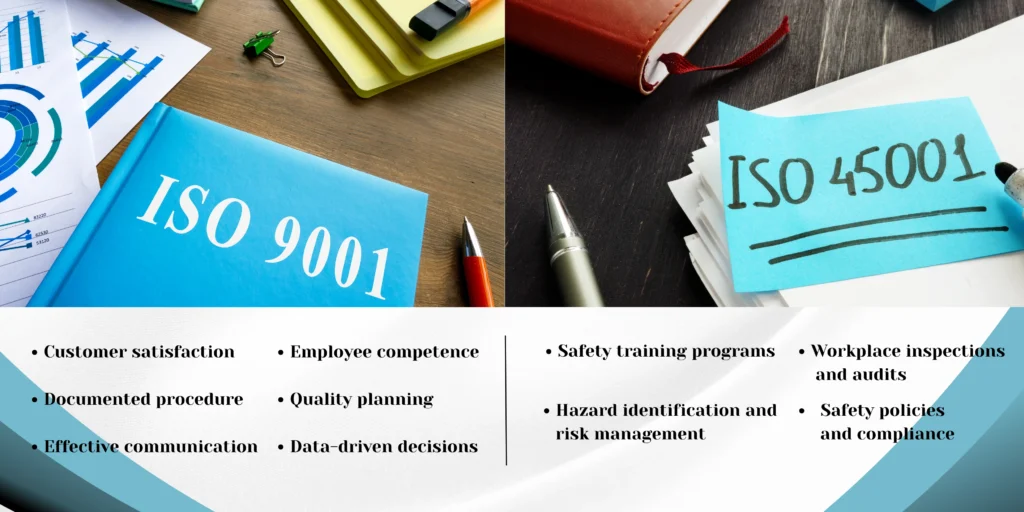
ISO 9001:2015 focuses on:
- Customer satisfaction
- Employee competence
- Documented procedures
- Quality planning
- Effective communication
- Data-driven decisions
ISO 45001 focuses on:
- Hazard identification and risk management
- Safety training programs
- Safety policies and compliance
- Workplace inspections and audits
Following these standards creates a strong culture of quality and safety across the organization
ISO 9001:2015 Certification – What It Means for Your Business
Achieving an ISO 9001:2015 certification shows that your organization follows the latest and most advanced version of the standard. This globally recognized accreditation tells customers, partners, and regulators that:
You take quality seriously
Your processes are controlled
You are committed to continuous improvement
This certification can also help your company qualify for major tenders, contracts, and partnership opportunities.
The Role of Auditors and Consultants in ISO 9001
To get certified, companies undergo internal and external audits. These audits are conducted by professionals such as:
ISO certified auditors
Individuals with auditor ISO certification
Businesses often hire ISO consultants to prepare documentation, train employees, close gaps, and make the certification journey easier. Their guidance ensures that the company meets all the QMS certification requirements smoothly.
ISO Certification Cost – What Should You Expect?
There is no fixed price for ISO certification. The ISO certification cost depends on:
- Business size
- Number of employees
- Number of locations
- Level of existing documentation
- Type of industry
Most small and medium businesses find the cost manageable—especially with expert support.
Understanding ISO 45001 – The Global Health & Safety Standard
While ISO 9001 handles quality, ISO 45001 focuses on workplace health and safety. It helps companies create safer environments, reduce risks, prevent accidents, and nurture a positive safety culture.
ISO 45001 replaced the old OHSAS 45001 standard and is now the globally accepted benchmark for occupational health and safety. This makes ISO 45001 occupational health and safety one of the most crucial certifications for any business with operational, physical, or environmental risks.

Why Workplace Safety Matters More Than Ever
Organizations worldwide now realize that protecting employees is not just a legal obligation—it’s a moral and strategic responsibility.
With health and safety ISO 45001 Certification, businesses can:
- Reduce injuries
- Improve compliance
- Build employee confidence
- Lower insurance costs
- Enhance productivity
The ISO standards for safety provide a strong, internationally recognized framework that helps eliminate risks and improve workplace well-being.
How ISO 45001 Works – A Practical Safety Management Approach
The ISO 45001 safety management system focuses on:
- Hazard identification
- Risk assessment
- Emergency planning
- Worker involvement
- Incident reporting
- Preventive action
This systematic approach strengthens the overall ISO health and safety culture and ensures safer operations across all departments.
Key ISO 45001 Requirements
To become certified, businesses must follow certain requirements, such as:
Identifying and evaluating workplace hazards
Implementing safety training programs
Developing safety policies
Monitoring and reviewing safety performance
Regular internal audits and inspections
When implemented well, these occupational health and safety ISO standards greatly reduce accidents and business risks.
ISO 45001 Certification Cost – What Influences It?
Just like ISO 9001, the certification cost for ISO 45001 depends on:
- Company size
- Number of work sites
- Level of workplace risk
- Safety documentation
High-risk industries may require more detailed audits, while low-risk businesses may complete certification more quickly.
Role of ISO 45001 Lead Auditors
Professional ISO 45001 lead auditors conduct certification audits, review safety processes, and ensure your company complies with the OHSMS requirements. These auditors undergo specialized training under recognized ISO safety certification programs and are essential to the certification process.
Why ISO 9001 and ISO 45001 certification Is the Best Combination for Businesses
Combining these two certifications gives your business the perfect balance of:
Quality (ISO 9001)
Safety (ISO 45001)
Together, they help organizations:
- Improve performance
- Reduce workplace risks
- Build strong customer trust
- Enhance brand value
- Increase operational efficiency
Create long-term business sustainability
Companies that adopt both standards experience fewer disruptions, better productivity, and stronger overall growth.
Conclusion
Quality and safety are the two pillars of long-term business success. ISO 9001 helps you deliver consistent, reliable products and services, while ISO 45001 ensures a safer and more secure workplace for your team.
By achieving these certifications, your organization demonstrates commitment to excellence, efficiency, responsibility, and the well-being of both customers and employees.
In simple words: ISO 9001 + ISO 45001 = A stronger, safer, more successful business. These certifications are not just badges—they are powerful tools for continuous improvement, global recognition, and sustainable growth.
Frequently Asked Questions (FAQs)
1. What is the difference between ISO 9001 and ISO 45001?
ISO 9001 deals with quality management and customer satisfaction, while ISO 45001 focuses on employee health, safety, and risk prevention. Together, they create a balanced system for business excellence.
2. How long does it take to get ISO 9001 and ISO 45001 certified?
The process usually takes 4 to 12 weeks, depending on company size, readiness, and existing systems.
3. What is the cost of ISO 9001 and ISO 45001 certifications?
Costs vary based on business size, locations, scope, and risk levels. Expenses usually include audits, documentation, consulting, and training.
4. Do I need a dedicated team to manage ISO certifications?
Not necessarily. Many businesses handle ISO requirements with existing staff. External consultants or ISO certified auditors can also support the process.
5. Are ISO 9001 and ISO 45001 required by law?
No, but many industries, clients, and government tenders prefer or require businesses to be ISO certified for quality or safety.
6. Why should companies get both certifications together?
Because this combination strengthens quality, reduces risks, improves productivity, and boosts customer trust—all at the same time.
Frequently Asked Questions (FAQs)
ISO Standards
- ISO 9001 Certification
- ISO 14001 Certification
- ISO 20000 Certification
- ISO 45001 Certification
- ISO 27001 Certification
Global PREESENCE